How Water Parks Keep Their Water Clean
When I was sixteen and working at Oceans of Fun in Kansas City, I assumed the entire water park ran on one giant pool filter and a truck full of chlorine.
The reality was considerably more sophisticated.
One morning before the park opened, a supervisor walked me through the pump house behind one of the main pools. The noise was startling — massive pumps running constantly, pushing thousands of gallons per minute through sand filters, past chemical injection points, and back into the pool.
:::stat
The water you splash into at 10 AM has been filtered, treated, and recirculated dozens of times since the park closed the night before.
:::
That backstage tour answered a question every parent has but rarely asks: how is this water actually clean? Thousands of people are swimming in it. Kids are peeing in it. People are sweating, shedding sunscreen, losing band-aids.
The answer involves chemistry, engineering, constant monitoring, and regulatory oversight.
How water parks treat their water — at a glance
| Layer | What it does | Typical target |
|---|---|---|
| Circulation + filtration | Removes physical debris and particles | Full turnover every 2–6 hours |
| Free chlorine | Kills bacteria and viruses on contact | 2–4 ppm |
| pH control | Keeps chlorine effective | 7.2–7.8 |
| Cyanuric acid (outdoor) | Protects chlorine from UV breakdown | 30–50 ppm |
| UV treatment (secondary) | Neutralizes Cryptosporidium, parasites chlorine misses | Pathogen kill in seconds |
| Ozone treatment (secondary) | Reduces chloramines and chemical smell | Improves water clarity |
| Manual testing | Verifies automated systems | Every 2 hours during operation |
The filtration system: moving water constantly
The foundation of water park sanitation is circulation. Water that sits still breeds bacteria.
Every pool, slide landing area, lazy river, and wave pool has its own dedicated circulation system designed to turn over the entire water volume multiple times per day.
:::stat
Standard pools: full filtration every 6 hours.
High-traffic wave pools and splash pads: every 2–4 hours.
:::
The CDC's Model Aquatic Health Code sets the baseline. Water parks typically exceed it because their bather loads are dramatically higher than neighborhood pools.
Filtration types
| Method | Trap size | Typical use |
|---|---|---|
| Sand filtration | 20–40 microns | Most outdoor parks (incl. older facilities) |
| Diatomaceous earth (DE) | 3–5 microns | High-end residential, some commercial |
| Regenerative media | Combines sand + DE + synthetic media | Newer indoor resorts (Kalahari) |
For reference, a human hair is about 70 microns wide. Sand filtration alone catches everything visible to the naked eye.
At Oceans of Fun, the main pool complex used high-rate sand filters in banks of four or six. Maintenance staff backwashed them by reversing the water flow to flush trapped debris.
Chemical treatment: more than just chlorine
Chlorine gets all the attention, but modern water park treatment is multi-layered.
Free chlorine
The primary disinfectant. Kills bacteria, viruses, and pathogens on contact.
| Pool type | Target |
|---|---|
| Residential | 1–3 ppm |
| Commercial water park | 2–4 ppm |
At 3 ppm, chlorine neutralizes most common waterborne pathogens within minutes.
:::note
Parks don't dump chlorine manually. Automated chemical feed systems take readings every few minutes and adjust the feed rate in real time. When a wave pool goes from 50 to 500 guests, the system detects the chlorine demand spike and compensates automatically.
:::
pH control
Chlorine's effectiveness depends heavily on pH:
| pH | % of chlorine in active form |
|---|---|
| 7.2 | ~65% |
| 7.5 | ~50% |
| 8.0 | ~25% |
The same amount of chlorine is three times less effective if pH drifts too high. Parks use muriatic acid or carbon dioxide injection to keep pH between 7.2 and 7.8.
Cyanuric acid (outdoor stabilizer)
Outdoor parks need this because direct sunlight can destroy 90% of free chlorine in two hours without stabilization. Indoor parks need less or none.
Secondary disinfection: UV and ozone
:::warning{title="Why UV matters: Cryptosporidium"}
Crypto is a parasite that forms a hard outer shell resistant to chlorine. It can survive in a properly chlorinated pool for over a week. UV treatment neutralizes it in seconds — which is why modern parks invest heavily in UV.
:::
Ozone is another secondary system. It breaks down organic contaminants, improves water clarity, and reduces the amount of chlorine needed.
The combined chlorine byproducts that cause "pool smell" and eye irritation are reduced significantly in parks that use ozone. If you've visited a park where the water didn't have a strong chemical smell despite being crystal clear, ozone was likely part of the system.
Volcano Bay at Universal Orlando uses a combination of these advanced treatment methods, which is one reason the water quality there feels noticeably different from older parks.
Testing: how often and by whom
The chemical automation systems handle moment-to-moment adjustments, but they don't replace manual testing.
| Test type | Frequency | Who does it |
|---|---|---|
| Manual chlorine + pH | Every 2 hours during operation | Aquatics staff |
| Health department inspection | Quarterly to monthly | State/county inspector |
| Full-time water quality manager | Continuous monitoring | Specialized technician (large resorts only) |
At Oceans of Fun, aquatics staff tested the main pools every two hours. Testing involved collecting a water sample, running it through a DPD test kit for free chlorine and combined chlorine, and checking pH with a phenol red indicator.
If any reading fell outside acceptable ranges, the attraction was temporarily closed until levels corrected.
The CDC's Healthy Swimming program provides guidance most state regulations are based on.
:::note
Inspection results are usually public record. Many health departments publish them online. Search "[your park name] + health inspection" — most large parks have results listed.
:::
Splash pads and zero-depth areas: a different challenge
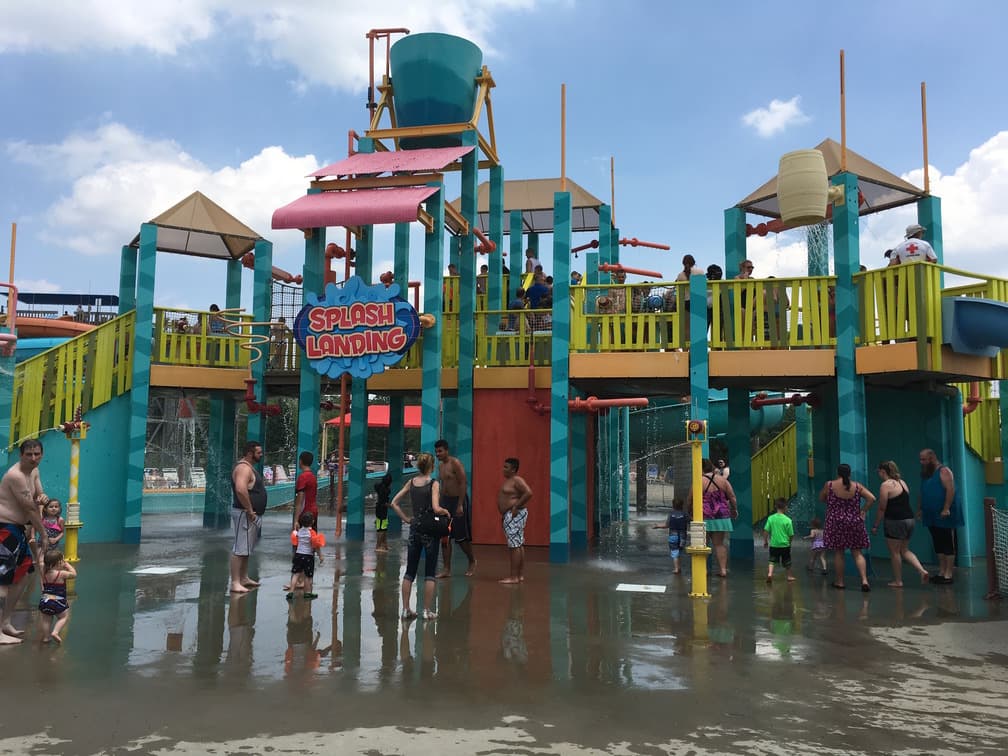
If you're taking toddlers to a water park, the splash pad is probably where you'll spend most of your time. These areas present unique water quality challenges.
Traditional splash pads are recirculating systems. Water sprays up from the ground, flows across the play surface where children are sitting, drains through a collection system, gets filtered and treated, and returns to the spray features.
The water touches the ground surface constantly, picking up everything on the deck: sunscreen, dirt, organic matter, whatever guests track in.
:::warning
Splash pad water typically requires higher turnover than pools because of ground contact. Some newer splash pads use flow-through systems where fresh water runs through and drains to waste — more expensive to operate, but eliminates recontamination risk.
:::
Several outbreaks of Cryptosporidium and other waterborne illnesses have been traced to improperly maintained splash pads. Parks that take water quality seriously treat their splash pad systems with the same rigor as their main pools.
For best toddler-area choices, see our best water parks for toddlers guide.
What guests do that makes the job harder
Working at a water park stripped away any illusions about guest behavior. Three things create real problems.
Sunscreen runoff
When hundreds of people enter a pool coated in sunscreen, the organic compounds react with chlorine and consume it.
:::stat
A wave pool at 3 ppm of free chlorine can drop below 2 ppm within an hour of a large crowd entering, purely from sunscreen demand.
:::
Spray sunscreens are particularly problematic — they coat the water surface with an oily film that's harder to filter than dissolved compounds. See our reef-safe sunscreen guide for stay-on options that don't trash water quality.
Swim diapers are not watertight
The CDC is explicit about this. Swim diapers contain solid waste reasonably well. They do not contain liquid waste or diarrhea.
A child with diarrhea wearing a swim diaper can contaminate an entire pool.
:::warning
Parks respond to "fecal incidents" by clearing the pool, hyperchlorinating to 20+ ppm, and keeping the pool closed for hours while the chlorine contact time neutralizes potential pathogens. I saw this enacted multiple times at Oceans of Fun during busy summer weekends.
:::
Not showering before entering
Most parks have shower stations at the entrance and signs asking guests to rinse off. Compliance is essentially zero.
Pre-swim showering removes sweat, body oils, cosmetics, and trace fecal matter that every person carries. Removing those contaminants before they enter the water reduces chlorine demand and improves quality for everyone.
The World Waterpark Association recommends pre-swim showers as a basic hygiene practice.
Indoor vs. outdoor: different challenges
| Challenge | Indoor parks | Outdoor parks |
|---|---|---|
| Chloramine accumulation (pool smell) | Major issue — air quality matters | Disperses into atmosphere |
| UV degradation of chlorine | Not a factor | Stabilizer chemicals required |
| Wind-blown debris (leaves, pollen) | Not a factor | Constant management |
| Rain dilution | Not a factor | Contaminants + chemical dilution |
| Sun-warmed water | No | Free temperature management |
Well-managed indoor parks address chloramine through:
- Aggressive ventilation systems
- Dehumidification
- Secondary disinfection (UV and ozone) to prevent chloramine formation
:::tip
If you walk into an indoor water park and the chemical smell is overwhelming, that's a sign the ventilation system is undersized or secondary treatment is inadequate. The best indoor parks let you spend several hours inside without eye irritation or coughing.
:::
During my visits to Kalahari's Sandusky location and the Wisconsin Dells indoor parks, I've been impressed by how manageable the indoor air feels. That's not an accident — it's the result of significant HVAC investment.
How to evaluate water quality as a guest
You can't test chlorine levels yourself, but you can make reasonable judgments using your senses.
| Signal | What to look for |
|---|---|
| Clarity | Should see the bottom clearly; haze, cloudiness, or green tint = leave |
| Smell | Faint chlorine smell = normal; strong harsh chemical odor = high chloramines (system struggling) |
| No chlorine smell at all in busy pool | Concerning — might mean levels are too low |
| Tile and deck condition | Clean tiles + clear drains + pressure-washed surfaces = good maintenance culture |
| Health inspection scores | Many parks must display recent results; many states publish online |
The bottom line for parents
:::key
Water parks at the professional level maintain water quality standards that exceed what most residential pools achieve. The combination of continuous filtration, automated chemical treatment, secondary disinfection, and regular testing creates a system with multiple redundancies — when one layer falls slightly below optimal, other layers compensate.
:::
That said, not every park invests equally. Large resort operations and major chain parks generally have the resources and corporate standards to maintain excellent water quality. Smaller independent parks and municipal splash pads vary more widely.
For help finding parks with the best facilities, browse our explore page or our best water parks for toddlers guide if you're particularly focused on splash-pad water quality.
The water at a well-managed water park is safe. Understanding the systems that make it safe gives you the knowledge to choose parks that take it seriously and recognize the ones that don't.
Brian Williams
Brian has been passionate about water parks since childhood and worked at one as a teenager. He founded Water Parks World to help families find the best water park experiences across America.